A doctor tells you that you have grade 2 piles, and you nod along. Then you get home and start wondering. Is it serious? Will it get worse? Do you need surgery?
Understanding piles stages answers most of those questions. The grade shows how far the swelling has moved, and that one detail guides almost every treatment decision that follows.
But what do early piles actually look like? Here are the signs to watch for and the steps you can take.
How Doctors Grade Piles Stages
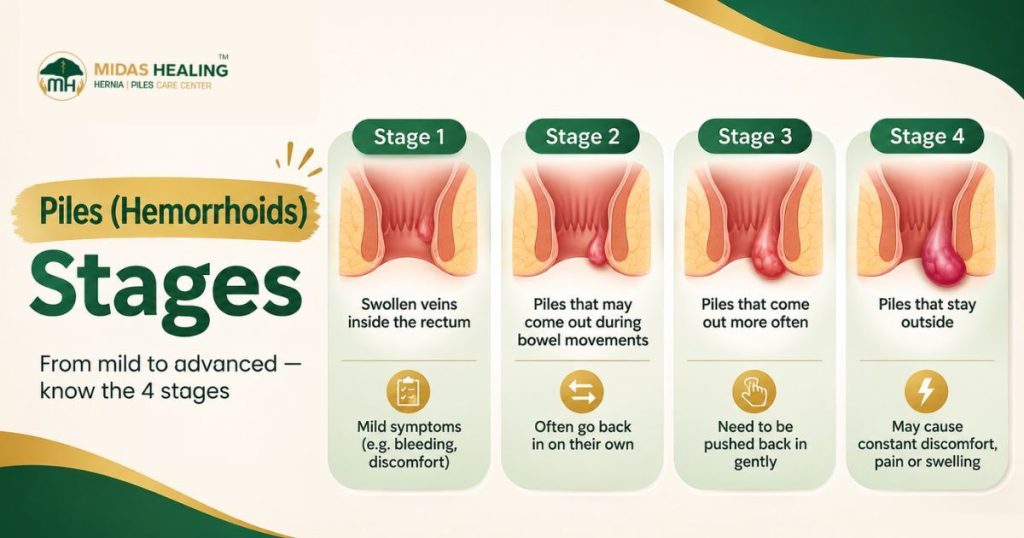
Internal piles are graded from 1 to 4. The scale doesn’t measure pain. It measures prolapse, which means how far the swollen tissue slips out of the back passage.
That surprises a lot of people. A painful lump isn’t automatically advanced, and a painless one isn’t always mild. External piles, which form under the skin around the anus, sit outside this system and are assessed differently.
The Quiet Phase: Grade 1 and Grade 2
Grade 1: Present but Hidden
Grade 1 piles stay inside the anal canal. You can’t see or feel them from outside. The usual clue is bright red blood on the toilet paper or in the pan, with little or no discomfort.
Grade 2: Out and Back Again
At grade 2, the swelling pushes out when you pass a stool and then slips back in by itself. You might notice itching, a feeling of fullness or a small lump that comes and goes.
Both grades respond well to early action. More fibre, plenty of water and less straining on the toilet ease the pressure that keeps piles growing. Knowing your exact piles stage at this point gives you the best chance of avoiding a procedure later.
When Piles Stop Going Back: Grade 3 and Grade 4
Grade 3: Needs a Helping Hand
Grade 3 piles come out during a bowel movement and stay out until you push them back with a finger. Mucus discharge, irritation and soreness become more common at this point.
Grade 4: Permanently Outside
Grade 4 piles hang outside the anus all the time and can’t be pushed back. They can grow quite large. In some cases a blood clot forms inside, and that causes sudden, severe pain.
Why Your Grade Decides the Treatment
Treatment follows the grade closely. A patient leaflet from St George’s University Hospitals NHS Foundation Trust explains that banding is a common treatment for grade 2 and 3 haemorrhoids, while grade 4 haemorrhoids are treated by surgical removal. Grade 1 piles usually settle with diet changes, fluids and soothing creams.
You’ll also see these grades called hemorrhoid stages in American medical writing. The spelling differs, but the scale is the same.
One caution matters more than any label. Rectal bleeding can come from conditions other than piles, so a doctor should always examine it rather than you assuming the cause.
Don't Wait for Grade 4 to Act
Piles that are left alone can grow from one grade to the next. And each step up narrows the list of simple options. Catching them early keeps treatment lighter and recovery quicker.
If you’ve noticed bleeding, a lump or discomfort that won’t settle, it’s worth getting checked properly. Dr. Chetan Mhaske and the team at MIDAS Healing in Pune assess every case on its own merits, so your plan fits your grade rather than a one-size-fits-all approach.
Book a consultation with MIDAS Healing to find out exactly where you sit among the piles stages, and what makes sense next.
📋 In This Article
- How Doctors Grade Piles Stages
- The Quiet Phase: Grade 1 and Grade 2
- When Piles Stop Going Back: Grade 3 and Grade 4
- Why Your Grade Decides the Treatment
- Don't Wait for Grade 4 to Act
- Frequently Asked Questions
Get Expert Consultation – Only ₹399
Get Expert Consultation – Only ₹399
Phone
+91 7070700684
+91 7070700683
midashealing1@gmail.com
Frequently Asked Questions
1.Can grade 1 piles turn into grade 4?
Yes, they can progress if the causes go unchecked. Grade 1 piles can enlarge to grade 2 or beyond, especially with ongoing constipation and straining. Early changes to diet, fluids and toilet habits help slow or stop that progression.
2. Are piles stages based on pain?
No. The four piles stages are based on prolapse, meaning how far the swelling moves out of the anus. Pain isn’t part of the grading. Early piles are usually painless, while a blood clot can make larger piles very painful.
3. Do all piles need surgery?
No. Many grade 1 and 2 piles improve with lifestyle changes and simple treatments, and banding is common for grades 2 and 3. Surgery is usually kept for grade 4 piles or for those that don’t respond to other methods
4. How does a doctor confirm my grade?
The doctor asks about your symptoms and then examines your back passage. This usually includes a gentle internal check, and sometimes a proctoscope, a short tube that gives a clear view of the anal canal. Those findings confirm the grade.
5. When should I see a doctor about piles?
See a doctor if you notice rectal bleeding, a lump that won’t go back in or symptoms that haven’t improved after a week of home care. Bleeding should always be checked, because other bowel conditions can cause it too.