MIDAS Healing Center
Updated Sept 2026 · Pune
A hernia rarely announces itself with a dramatic moment of pain. More often, it starts quietly, a small bulge that shows up when you cough, stand up too fast, or lift something heavier than usual. Because the change seems so minor, most people brush past it. But learning to spot the early signs of hernia can make the difference between a straightforward check-up and a problem that grows into something harder to manage.
A hernia forms when internal tissue pushes through a weak point in the surrounding muscle wall. This can happen in the groin, near the belly button, or around the site of an old surgical scar. Some hernias barely cause discomfort in the beginning, which is exactly why they get overlooked for months.
A noticeable bulge or swelling
This is usually the clearest of all the early signs of hernia, and often the first thing people mention to a doctor.
You might spot a small lump near the groin, abdomen, or navel. It tends to stand out more when you’re upright, coughing, sneezing, or straining, and it often flattens out once you lie down. Someone may notice this while getting dressed in the morning, then forget about it by lunchtime because it’s no longer visible. That disappearing act doesn’t make it any less worth mentioning at your next appointment.
Discomfort while lifting or exercising
A hernia can create a pulling or pressure-like sensation the moment you lift a suitcase, carry shopping bags, or push through a workout.
It rarely feels like a sharp jab. People describe it more as heaviness, or an odd tightness in one spot that wasn’t there before. If that feeling keeps returning every time you exert yourself, it’s worth resisting the urge to write it off as a pulled muscle.
Pain that increases with coughing or straining
Coughing, sneezing, and straining all raise the pressure inside your abdomen. If there’s already a weak spot in the muscle wall, these everyday actions can make things noticeably worse.
You may feel a short, sharp ache when you cough, followed by quick relief once it passes. On their own, these moments seem trivial. Together, though, they’re among the more telling warning signs of hernia, and they deserve a proper look rather than a shrug.
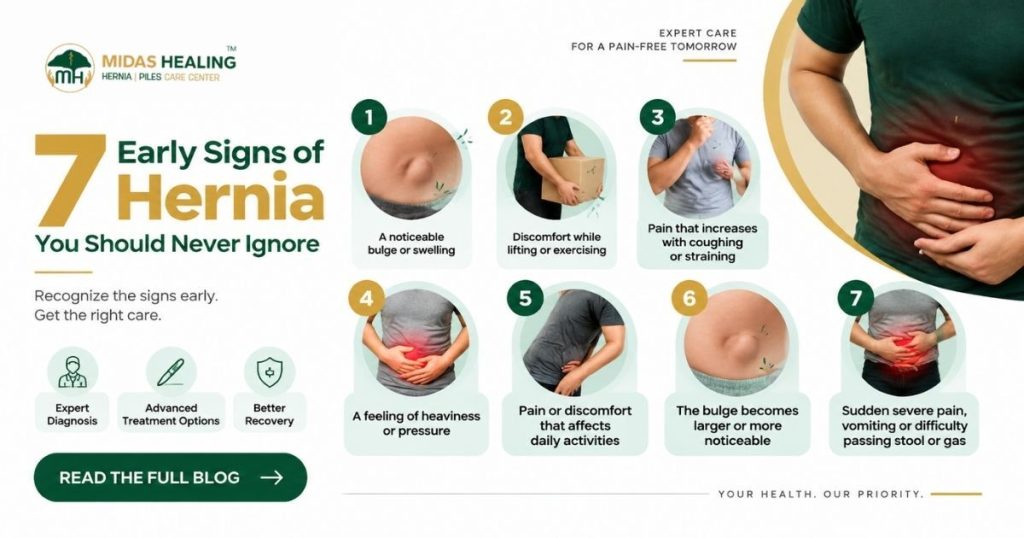
A feeling of heaviness or pressure
Not every hernia comes with pain attached.
Sometimes it’s just a strange fullness or dragging sensation around the groin or lower abdomen, one that tends to build after a long day on your feet. Because it doesn’t stop you from going about your day, it’s easy to dismiss. Persistent pressure, though, is still worth flagging to a doctor rather than living with indefinitely.
Pain or discomfort that affects daily activities
Once walking, climbing stairs, bending, or exercising starts feeling harder because of a swelling or an unusual sensation, that’s a signal to pay closer attention. Many people wait until the pain becomes severe before booking an appointment, but hernia symptoms vary so widely from person to person that intensity alone isn’t a reliable guide to how urgent things are.
The bulge becomes larger or more noticeable
A lump that keeps growing shouldn’t be left to sort itself out.
It might start off appearing only after a cough or a heavy lift. Over time, it can become visible even while standing normally. Watching it change from week to week isn’t a substitute for a clinical opinion, and among the early signs of hernia, this one tends to signal that things are progressing.
Sudden severe pain, vomiting or difficulty passing stool or gas
This sits in a different category altogether from the milder symptoms above.
If a hernia suddenly turns very painful, hard, swollen, or impossible to push back in, especially alongside vomiting or trouble passing stool or gas, it could point to a complication such as incarceration or obstruction. Don’t try to wait this one out at home.
What happens during hernia diagnosis?
Most doctors start simple: they’ll ask what you’re feeling, since when, and what makes it worse. A physical exam comes next. Only if something’s unclear does imaging enter the picture.
Here’s the thing, though, not every lump turns out to be a hernia at all. That’s exactly why hernia diagnosis matters so much before jumping to conclusions. It sorts out what’s actually causing the swelling, and whether you need treatment or just a watchful eye.
MIDAS Healing offers both laparoscopic and robotic options for hernia care, and the choice comes down to what suits each patient best. You’ll find the centre in Hadapsar, Pune, under Dr. Chetan Mhaske, Consultant General and Laparoscopic Surgeon.
Don't wait for the pain to become unbearable
Small bulge. A pull while lifting something ordinary. Discomfort that shows up, fades, then comes back uninvited. That’s often how the early signs of hernia play out in real life, and none of it demands panic. What it does demand is attention once the swelling sticks around or starts to change.
So if any of this rings a bell, don’t sit on it. A qualified surgeon can tell you fairly quickly what’s actually going on and whether treatment is even needed. Dr. Chetan Mhaske and the team at MIDAS Healing handle hernia cases in Pune with that same approach: look closely first, decide after.
📋 In This Article
- A noticeable bulge or swelling
- Discomfort while lifting or exercising
- Pain that increases with coughing or straining
- A feeling of heaviness or pressure
- Pain or discomfort that affects daily activities
- The bulge becomes larger or more noticeable
- Sudden severe pain, vomiting or difficulty passing stool or gas
Get Expert Consultation – Only ₹399
Error: Contact form not found.
Get Expert Consultation – Only ₹399
Phone
+91 7070700684
+91 7070700683
midashealing1@gmail.com
Frequently Asked Questions
1. What is the first sign of a hernia?
Usually it’s a bulge you can actually see, near the groin or abdomen. This tends to be one of the earliest signs of hernia patients report, showing up more while standing or straining and easing off once you lie down. Still, get a doctor to confirm it.
2. Can a hernia exist without pain?
Yes, quite often. Many hernias cause little more than a bulge, pressure, or heaviness in the early stages. The lack of pain doesn’t mean the condition is harmless, so it shouldn’t stop you from getting it checked properly.
3. When should hernia symptoms become an emergency?
If the pain turns sudden and severe, or the bulge hardens and grows fast, that’s not something to sit with. Add vomiting or trouble passing stool or gas to the mix, and you’re looking at a possible complication. Skip the routine booking and get seen straight away.
4. How is a hernia diagnosed?
It starts with a chat, really, your symptoms, your history, then a hands-on exam. From there, depending on what the doctor finds and where the swelling sits, an ultrasound or similar scan might get added to confirm exactly what’s going on.
5. Does every hernia require surgery?
Not necessarily. A lot rides on the type, the size, how much it’s bothering you, and your general health. Some smaller ones just get watched over time. Others, especially symptomatic or complicated cases, will need repair. Your surgeon decides after actually examining you.